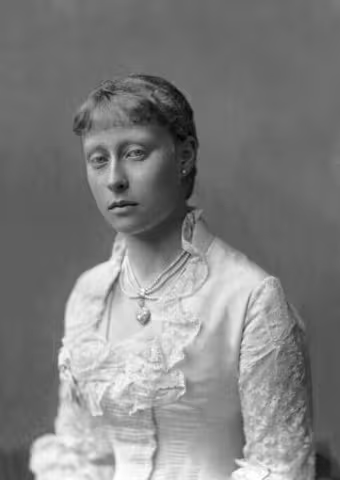
Princess Victoria of Hesse and by Rhine (5 April 1863 – 24 September 1950), later Princess Louis of Battenberg and then Victoria Mountbatten, Marchioness of Milford Haven, was the eldest daughter of Louis IV, Grand Duke of Hesse and by Rhine, and Princess Alice of the United Kingdom.
Victoria was born at Windsor Castle in the presence of her namesake grandmother, Queen Victoria. She was raised in Germany and England. Her mother died while Victoria and her siblings were still young, placing her in an early position of responsibility within the family. Despite her father's disapproval, she married his morganatic first cousin, Prince Louis of Battenberg, an officer in the British Royal Navy. Victoria lived in various parts of Europe during her husband's naval career and through visits to her many royal relations. She was regarded by her family as liberal in outlook, straightforward, practical, and intelligent. The couple had four children: Alice, Louise, George, and Louis.
During World War I, Victoria and her husband abandoned their German titles and adopted the surname Mountbatten, an anglicised version of the German "Battenberg". Two of her sisters – Elisabeth and Alix, who had married into the Russian imperial family – were murdered during the Russian revolution. After World War II, her daughter Louise became queen consort of Sweden and her son Louis was appointed the last Viceroy of India. She was the maternal grandmother of Prince Philip, Duke of Edinburgh, consort of Queen Elizabeth II, and the paternal great-grandmother of King Charles III.
Early life

Victoria was born on Easter Sunday in 1863 at Windsor Castle, in the presence of her maternal grandmother, Queen Victoria. The eldest daughter of Princess Alice and Louis IV, Grand Duke of Hesse, she was baptised into the Lutheran faith in the Green Drawing Room at Windsor Castle on 27 April, and was held in the Queen's arms during the ceremony. Her godparents were Queen Victoria; Princess Mary Adelaide of Cambridge; Louis III, Grand Duke of Hesse and by Rhine (represented by Prince Alexander of Hesse and by Rhine); the Prince of Wales; and Prince Heinrich of Hesse and by Rhine.
Victoria spent her early childhood in Bessungen, a suburb of Darmstadt, before the family moved to the New Palace in Darmstadt when she was three. She shared a room with her younger sister, Elisabeth, until they reached adulthood. Privately educated to a high standard, she remained an avid reader throughout her life.

During the Prussian invasion of Hesse in June 1866, Victoria and Elisabeth were sent to Britain to live with their grandmother until hostilities ended with the absorption of Hesse-Kassel and parts of Hesse-Darmstadt into Prussia. During the Franco-Prussian War of 1870, military hospitals were established in the palace grounds at Darmstadt, and Victoria assisted her mother in the soup kitchens. She later recalled the severe winter cold and an incident in which her arm was burned by hot soup.
In 1872, Victoria's eighteen-month-old brother, Friedrich, was diagnosed with haemophilia. The news shocked Europe's royal families; it had been two decades since Queen Victoria had given birth to her haemophiliac son, Prince Leopold, Duke of Albany, and Friedrich's diagnosis was the first clear indication that the disorder was hereditary within the royal family. The following year, Friedrich fell from a window onto stone steps and died, marking the first of several tragedies to affect the Hesse family.

In early November 1878, Victoria contracted diphtheria. Elisabeth was quickly moved from their shared room and was the only member of the family to avoid infection. For several days, Victoria's mother nursed the sick, but she was unable to save her youngest daughter, Marie, who died in mid-November. Just as the remaining family members appeared to be recovering, Alice fell ill. She died on 14 December, the anniversary of the death of her father, Prince Albert. As the eldest child, Victoria assumed some of her mother's responsibilities, caring for her younger siblings and supporting her father. She later wrote, "My mother's death was an irreparable loss ... My childhood ended with her death, for I became the eldest and most responsible".
Marriage and family
At family gatherings, Victoria had often met Prince Louis of Battenberg, her first cousin once removed and a member of a morganatic branch of the Hessian royal family. Louis had adopted British nationality and was serving as an officer in the Royal Navy. They met again in Darmstadt in the winter of 1882 and became engaged the following summer.
After a brief postponement because of the death of her maternal uncle, Prince Leopold, Duke of Albany, Victoria married Louis on 30 April 1884 in Darmstadt. Her father disapproved of the match; in his view, Louis – his own first cousin – had little money and would take Victoria abroad to live in Britain, depriving him of her company. Victoria, however, was independent‑minded and paid little heed to her father's objections. Remarkably, that same evening, her father secretly married his mistress, Countess Alexandrine von Hutten-Czapska, the former wife of Alexander von Kolemine, the Russian chargé d'affaires in Darmstadt. His marriage to a divorcee of unequal rank shocked Europe's royal houses, and diplomatic and family pressure forced him to seek an annulment.
Over the next sixteen years, Victoria and Louis had four children:
| Name | Birth | Death | Marriage |
|---|---|---|---|
| Alice | 25 February 1885 | 5 December 1969 | Married 1903 Prince Andrew of Greece and Denmark Five children, including Prince Philip, Duke of Edinburgh |
| Louise | 13 July 1889 | 7 March 1965 | Married 1923 King Gustaf VI Adolf of Sweden (his second marriage) One stillborn daughter |
| George | 6 November 1892 | 8 April 1938 | Married 1916 Countess Nadejda Mikhailovna de Torby (daughter of Grand Duke Michael Mikhailovich of Russia) Two children |
| Louis | 25 June 1900 | 27 August 1979 | Married 1922 Hon. Edwina Ashley Two children |

The couple lived in a succession of houses in Chichester and Walton-on-Thames in England, and at Schloss Heiligenberg in Germany. When Louis was serving with the Mediterranean Fleet, Victoria spent several winters in Malta. In 1887, she contracted typhoid but, after being nursed through her illness by her husband, had recovered sufficiently by June to attend Queen Victoria's Golden Jubilee celebrations in London. She had an interest in science, drew a detailed geological map of Malta, and took part in archaeological excavations both on the island and in Germany. She kept meticulous leather‑bound volumes recording the books she read, which show a wide range of subjects, including socialist philosophy.
The family were present at Windsor for Queen Victoria's funeral service at St George's Chapel. Under the terms of the late Queen's will, Victoria received an increase of £2,000 in her annual income.
She personally educated her children and introduced them to new ideas and inventions. She taught her younger son, Louis, until he was ten years old. He later said of her, in 1968, that she was "a walking encyclopedia. All through her life she stored up knowledge on all sorts of subjects, and she had the great gift of being able to make it all interesting when she taught it to me. She was completely methodical; we had time-tables for each subject, and I had to do preparation, and so forth. She taught me to enjoy working hard, and to be thorough. She was outspoken and open-minded to a degree quite unusual in members of the Royal Family. And she was also entirely free from prejudice about politics or colour and things of that kind."
In 1906, she flew in a Zeppelin airship and later flew in a biplane even though it was "not made to carry passengers, and we perched securely attached on a little stool holding on to the flyer's back". Until 1914, Victoria regularly visited relatives abroad in both Germany and Russia, including her two sisters who had married into the Russian imperial family: Elisabeth, who had married Grand Duke Sergei Alexandrovich, and Alix, who had married Emperor Nicholas II. Victoria was among the Empress's relatives who attempted to dissuade her from the influence of Rasputin. At the outbreak of war between Germany and Britain in 1914, Victoria and her daughter, Louise, were in Russia in Yekaterinburg. Travelling by train and steamer, they reached St Petersburg and continued through Tornio to Stockholm, before sailing from Bergen, Norway, on "the last ship" back to Britain.
Later life and death

Louis was forced to resign from the navy at the start of the war when his German origins became an embarrassment, and the couple retired for the war years to Kent House on the Isle of Wight, which Victoria had been given by her aunt Princess Louise, Duchess of Argyll. Victoria blamed her husband's forced resignation on the Government "who few greatly respect or trust". She distrusted the First Lord of the Admiralty, Winston Churchill, because she thought him unreliable – he had once borrowed a book and failed to return it. Continued public hostility to Germany in the United Kingdom led King George V to renounce his German titles, and on 14 July 1917 Louis and Victoria renounced theirs, assuming an anglicised version of Battenberg – Mountbatten – as their surname. Four months later Louis was re-ennobled by the King as Marquess of Milford Haven. During the war, Victoria's two sisters, Alix and Elisabeth, were murdered in the Russian revolution, and her brother, Ernest Louis, Grand Duke of Hesse, was deposed. On her last visit to Russia in 1914, Victoria had driven past Ipatiev House in Yekaterinburg where Alix would be murdered. In January 1921, after a long and complex journey, Elisabeth's body was interred in Jerusalem in Victoria's presence. Alix's body was not recovered during Victoria's lifetime.

Victoria's husband died in London in September 1921. After meeting her at the Naval and Military Club in Piccadilly, he complained of feeling unwell, and Victoria persuaded him to rest in a room they had booked in the club annexe. She called a doctor, who prescribed some medicine, and Victoria went out to fill the prescription at a nearby pharmacy. When she returned, Louis was dead. Upon her widowhood, Victoria moved into a grace-and-favour residence at Apartment 7, Kensington Palace, and, in the words of her biographer "became a central matriarchal figure in the lives of Europe's surviving royalty". In 1930, her eldest daughter, Alice, suffered a nervous breakdown and was diagnosed as schizophrenic. In the following decade Victoria was largely responsible for her grandson Prince Philip's education and upbringing during his parents' separation and his mother's institutionalisation. Philip recalled, "I liked my grandmother very much and she was always helpful. She was very good with children ... she took the practical approach to them. She treated them in the right way – the right combination of the rational and the emotional."
In 1937, Victoria's brother, Ernest Louis, died, and soon afterwards her widowed sister-in-law, nephew, granddaughter and two of her great-grandchildren all died in an air crash in Ostend. Victoria's granddaughter, Princess Cecilie of Greece and Denmark, had married Victoria's nephew (Ernest Louis's son), Georg Donatus, Hereditary Grand Duke of Hesse. They and their two young sons, Louis and Alexander, were all killed. Cecilie's youngest child, Johanna, who was not on the plane, was adopted by her uncle Prince Louis of Hesse and by Rhine, whose wedding the crash victims were travelling to, but the child survived her parents and brothers by only eighteen months, dying in 1939 of meningitis.
Further tragedy followed when Victoria's son, George, died of bone cancer the following year. Her granddaughter, Lady Pamela Hicks, remembered her grandmother's tears. During World War II Victoria was bombed out of her Kensington Palace apartment in October 1940, and spent some time at Windsor Castle with King George VI. Her surviving son (Louis) and her two grandsons (David Mountbatten and Prince Philip) served in the Royal Navy, while her German relations fought with the opposing forces. She spent most of her time reading and worrying about her children; her daughter, Alice, remained in occupied Greece and was unable to communicate with her mother for four years at the height of the war. After the Allied victory, her son Louis was made Viscount Mountbatten of Burma. He was offered the post of Viceroy of India, but she was opposed to his accepting, knowing that the position would be dangerous and difficult; he accepted anyway.
On 15 December 1948, Victoria attended the christening of her great-grandson, Prince Charles. She was one of eight sponsors or godparents, along with King George VI, King Haakon VII of Norway, Queen Mary, Princess Margaret, Prince George of Greece and Denmark, Lady Brabourne, and David Bowes-Lyon.
She fell ill with bronchitis (she had smoked since the age of sixteen) at Lord Mountbatten's home at Broadlands, Hampshire, in the summer of 1950. Saying "it is better to die at home", Victoria moved back to Kensington Palace, where she died on 24 September aged 87. She was buried four days later in the grounds of St. Mildred's Church, Whippingham, on the Isle of Wight.

Legacy
With the help of her lady-in-waiting, Baroness Sophie Buxhoeveden, Victoria wrote a memoir, held in the Mountbatten archive at the University of Southampton, which remains a source for royal historians. A selection of Queen Victoria's letters to Victoria has been published with a commentary by Richard Hough and an introduction by Victoria's granddaughter, Patricia Mountbatten.
Lord Mountbatten remembered her fondly: "My mother was very quick on the uptake, very talkative, very aggressive and argumentative. With her marvellous brain she sharpened people's wits." Her granddaughter thought her "formidable, but never intimidating ... a supremely honest woman, full of commonsense and modesty". Victoria wrote her own typically forthright epitaph at the end of her life in letters to, and conversation with, her son: "What will live in history is the good work done by the individual & that has nothing to do with rank or title ... I never thought I would be known only as your mother. You're so well known now and no one knows about me, and I don't want them to."
Honours
 Grand Duchy of Hesse: Dame of the Order of the Golden Lion, 1 January 1883
 Kingdom of Prussia: Red Cross Medal, 1st Class
 Russian Empire: Dame Grand Cross of the Order of St. Catherine
 United Kingdom:
- Queen Victoria Golden Jubilee Medal, 1887
- Royal Order of Victoria and Albert, 1st Class


Ancestry
| Ancestors of Princess Victoria of Hesse and by Rhine |
|---|
References
| Grand Ducal Family of Hesse and by Rhine |
|---|
.svg) |
| Louis IV |
- ^ Hough, Richard (1984). Louis and Victoria: The Family History of the Mountbattens. Second edition. London: Weidenfeld and Nicolson. p. 28. ISBN 0-297-78470-6.
- ^ Queen Victoria's Journals – Monday 27 April 1863
- ^ Hough, p. 30
- ^ Hough, p. 29
- ^ Hough, p. 34
- ^ Hough, p. 36
- ^ a b c d e Vickers, Hugo (2004). "Mountbatten, Victoria Alberta Elisabeth Mathilde Marie, marchioness of Milford Haven (1863–1950)". In Matthew, H. C. G.; Harrison, Brian (eds.). Oxford Dictionary of National Biography. Oxford Dictionary of National Biography (online ed.). Oxford University Press. doi:10.1093/ref:odnb/66334. ISBN 978-0-19-861411-1. (Subscription, Wikipedia Library access or UK public library membership required.)
- ^ Hough, pp. 46–48
- ^ Hough, p. 50
- ^ Hough, p. 57
- ^ Hough, p. 114
- ^ Ziegler, Philip (1985). Mountbatten. London: Collins. p. 24. ISBN 0-00-216543-0.
- ^ Huberty, Michel; Giraud, F. Alain; Magdelaine, F. & B. (1976). L'Allemagne Dynastique: Tome I Hesse-Reuss-Saxe. Le Perreu: A. Giraud. p. 345. ISBN 2-901138-01-2.
- ^ Hough, pp. 117–122
- ^ Ziegler, Philip (2004). "Alice, Princess [Princess Alice of Battenberg; married name Princess Andrew of Greece]". In Matthew, H. C. G.; Harrison, Brian (eds.). Oxford Dictionary of National Biography. Oxford Dictionary of National Biography (online ed.). Oxford University Press. doi:10.1093/ref:odnb/66337. ISBN 978-0-19-861411-1. (Subscription, Wikipedia Library access or UK public library membership required.)
- ^ Ziegler, Philip (2004). "Mountbatten, George Louis Victor Henry Sergius, second marquess of Milford Haven". In Matthew, H. C. G.; Harrison, Brian (eds.). Oxford Dictionary of National Biography. Oxford Dictionary of National Biography (online ed.). Oxford University Press. doi:10.1093/ref:odnb/66662. ISBN 978-0-19-861411-1. (Subscription, Wikipedia Library access or UK public library membership required.)
- ^ Ziegler, Philip (2004). "Mountbatten, Louis Francis Albert Victor Nicholas, first Earl Mountbatten of Burma". In Matthew, H. C. G.; Harrison, Brian (eds.). Oxford Dictionary of National Biography. Oxford Dictionary of National Biography (online ed.). Oxford University Press. doi:10.1093/ref:odnb/31480. ISBN 978-0-19-861411-1. (Subscription, Wikipedia Library access or UK public library membership required.)
- ^ Hough, pp. 158–159
- ^ Hough, p. 169
- ^ Hough, pp. 213–214, 372 and 375
- ^ Vickers, Hugo (2000). Alice: Princess Andrew of Greece. Hamish Hamilton. p. 50. ISBN 9780241136867.
- ^ Hough, p. 177
- ^ Terraine, John; Foreword by Lord Mountbatten (1980). The Life and Times of Lord Mountbatten. London: Arrow Books Ltd. p. 6. ISBN 0-09-922630-8.
- ^ Victoria Milford Haven quoted in Hough, p. 215
- ^ Hough, p. 264
- ^ Hough, p. 289
- ^ Hough, p. 274
- ^ Vickers, Hugo (2000). Alice, Princess Andrew of Greece. London: Hamish Hamilton. p. 113. ISBN 0-241-13686-5.
- ^ Terraine, p. 10
- ^ Eilers, Marlene A. (1987). Queen Victoria's Descendants. Baltimore, Maryland: Genealogical Publishing Co. p. 187. ISBN 978-0-938311-04-1.
- ^ Hough, p. 288
- ^ Kerr, Mark (1934). Prince Louis of Battenberg. London: Longmans, Green and Co. p. 261.
- ^ Hough, p. 333
- ^ a b Fry, Helen (2017). The London Cage: The Secret History of Britain's World War II Interrogation Centre (Unabridged ed.). Yale University Press. pp. 9–10. ISBN 9780300231229. Retrieved 24 June 2025.
- ^ Hough, p. 338
- ^ Vickers, pp. 200–205
- ^ Prince Philip quoted in Hough, p. 354
- ^ Duff, David (1967). Hessian Tapestry. London: Muller. pp. 350–353. OCLC 565356978.
- ^ Hough, p. 365
- ^ Hough, pp. 375 and 382
- ^ Ziegler, p. 359
- ^ "The Christening of Prince Charles". Royal Collection Trust. Archived from the original on 17 December 2021. Retrieved 18 February 2022.
- ^ Hough, p. 53
- ^ Ziegler, p. 506
- ^ The memoir is available online.
- ^ Victoria; edited by Hough, Richard (1975). Advice to a grand-daughter: letters from Queen Victoria to Princess Victoria of Hesse. London: Heinemann. ISBN 0-434-34861-9.
- ^ Earl Mountbatten of Burma quoted in Hough, p. 339
- ^ Lady Pamela Hicks quoted in Hough, p. 373
- ^ Quoted in Hough, p. 387
- ^ "Goldener Löwen-orden", Großherzoglich Hessische Ordensliste (in German), Darmstadt: Staatsverlag, 1914, p. 1 – via hathitrust.org
- ^ a b c "Genealogie", Hof- und Staats-Handbuch des Großherzogs Hessen, 1904, p. 2
- ^ Joseph Whitaker (1897). An Almanack for the Year of Our Lord ... J. Whitaker. p. 110.
- ^ a b c d e f g h Weir, Alison (1996). Britain's Royal Families: The Complete Genealogy (Revised ed.). London: Pimlico. pp. 305–307. ISBN 0-7126-7448-9.
Further reading
- Massie, Robert K. (1995). The Romanovs: The Final Chapter. New York: Ballantine Books. ISBN 978-0-345-40640-8.
- Miller, Ilana D. (2011). The Four Graces: Queen Victoria's Hessian Granddaughters. East Richmond Heights, California: Kensington House Books. ISBN 978-0-9771961-9-7. A "sisters" biography of the four surviving daughters of Princess Alice, Grand Duchess of Hesse and by Rhine, told from the point of view of Princess Victoria.
- Miller, Ilana (2024) Queen Victoria's Favourite Granddaughter: Princess Victoria of Hesse and by Rhine the Most Consequential Royal You Never Knew Yorkshire: Pen & Sword History. ISBN 978-1-39906-626-6.
- Mountbatten, Victoria. Recollections of Victoria Mountbatten, Marchioness of Milford Haven (PDF).
External links
