.jpg)
In Greek mythology, Amalthea or Amaltheia (Ancient Greek: Ἀμάλθεια) is the figure most commonly identified as the nurse of Zeus during his infancy. She is described either as a nymph who raises the child on the milk of a goat, or, in some accounts from the Hellenistic period (c. 323–30 BC) onwards, as the goat itself.
From as early as the 6th century BC, there survive references to the "horn of Amalthea" (known in Latin as the cornucopia), a magical horn said to be capable of producing endless amounts of any food or drink desired. In a narrative attributed to the mythical poet Musaeus and dating to around the 4th century BC, Amalthea, a nymph, nurses the infant Zeus and owns a goat which is terrifying in appearance. After Zeus reaches adulthood, he uses the goat's skin as a weapon in his battle against the Titans (the earlier generation of gods). The first known author to describe Amalthea as a goat is the 3rd-century BC poet Callimachus, who presents a rationalised version of the myth in which Zeus is fed on Amalthea's milk. Aratus, also writing in the 3rd century BC, identifies Amalthea with the star Capella, and describes her as "Olenian" (the meaning of which is unclear).
Scholars disagree as to when the tale of Zeus's upbringing was first merged with that of the magical horn. They are explicitly combined by the Roman poet Ovid (1st century BC/AD), whose story of Zeus's nursing weaves together elements from multiple accounts. A passage from a marginal note in a manuscript of Aratus's version has been taken as evidence that the two myths may have been connected prior to Ovid. In the Fabulae, a 2nd-century AD mythological handbook, Amalthea hides the infant in a tree and gathers the Kouretes to dance noisily, so that the child's crying cannot be heard. Other accounts of Zeus's upbringing describe Amalthea as related to Melisseus, the mythical king of Crete, including an Orphic version of the story.
Among the few surviving representations of Amalthea in ancient art is a 2nd-century AD marble relief which represents her as a goat suckling Zeus, behind two dancing Kouretes. She is also depicted on multiple coins and medallions from the Roman Empire. Between the 16th and 18th centuries, she was the subject of works by painters such as Giorgio Vasari and Jacob Jordaens, and sculptors such as Gian Lorenzo Bernini and Pierre Julien.
Etymology and origins
The etymology of Amáltheia (Ἀμάλθεια) is unknown. Scholars from the 19th century made various proposals, among them derivations from álthō, althaínō (ἄλθω, ἀλθαίνω, 'to tend, to nourish') and amalḕ theía (ἀμαλὴ θεία, 'divine goat'). In 1917, Alfred Chilton Pearson described earlier etymologies as inadequate, suggesting that the name is related to amalós (ἀμαλός, 'soft, tender, weak') and amálē (ἀμάλη, 'sheaf, bundle'). The verb amaltheúein (ἀμαλθεύειν, 'to nurture') was thought by Otto Gruppe, writing in 1906, to derive from Amalthea's name. According to Pearson, the two words should instead be understood as having existed alongside each other, with this notion of "abundance" being embodied in certain mythological figures. In 1999, Gerard Mussies derived Amalthea's name from amalthḗs (ἀμαλθής, 'not softening'), which he saw as referring to the goat's udder, taut with milk.
There is no mention of Amalthea in Hesiod's Theogony, an 8th-century BC poem containing the earliest known account of Zeus's birth. Hesiod writes that the newborn Zeus is taken to a cave on "Mount Aigaion" on the island of Crete; some scholars interpret this as "Goat's Mountain" (aigós, αἰγός meaning "goat's"), and thus as related to the story of Amalthea. Other scholars, including Martin Litchfield West, see no reason to view the name for the mountain as referring to a goat. According to Apostolos Athanassakis, elements of the story of Zeus's raising such as Amalthea and the Kouretes (male figures who dance loudly around the child in some versions) have their origins in traditions from Crete.
Mythology
Horn of Amalthea

The "horn of Amalthea", later referred to in Latin literature as the cornucopia, is a magical horn generally described as being able to produce an inexhaustible supply of any food or drink desired. The tale of this horn seems to have originated as an independent tradition from that of Zeus's raising, though it is uncertain when the two merged. The "horn of Amalthea" is mentioned as early as the 6th century BC by poets such as Anacreon and Phocylides, and is commonly referenced in comedies, such as those by Cratinus, Aristophanes, and Antiphanes (who date to the 5th or 4th century BC). The 4th-century BC comic poet Eubulus composed a now-lost work titled Amaltheia, which Richard L. Hunter believes may have dealt with the horn-owning Amalthea and represented her as an innkeeper.
According to the Bibliotheca – a 1st- or 2nd-century AD mythological compendium by an author referred to as "Apollodorus" – the 5th-century BC mythographer Pherecydes described the horn's ability to provide endless food and drink as desired. Apollodorus also transmits that it is considered to belong to Amalthea, a nymph (a type of young, female divinity). In a lost poem by the 5th-century BC poet Pindar, Heracles fought against the river god Achelous (who was in the form of a bull) for the hand of Deianeira, and during the fight Heracles pulled off one of his opponent's horns. Achelous reclaimed this horn from Heracles by trading it for a magical horn obtained from Amalthea, a daughter of Oceanus. In the same passage in which he cites Pherecydes, Apollodorus retells this story; he describes the nymph Amalthea as the daughter of Haemonius, whose name, meaning "Thessalian", indicates that she is separate to the nurse of Zeus. In Apollodorus's account, Amalthea's horn is that of a bull (an element also mentioned by the 4th-to-3rd-century BC comic poet Philemon), seemingly a result of confusion with the bull's horn of Achelous. In the versions of the myth told by Diodorus Siculus (1st century BC) and Strabo (1st century BC/AD), the horn of Amalthea is identified with that of Achelous.
Nurse of Zeus
In stories of Zeus's infancy, Amalthea is the figure most commonly described as his nurse, and in this role she is often considered a nymph. She appeared in the account of Zeus's upbringing from the now-lost Eumolpia, probably a theogony composed in or before the second half of the 4th century BC, and attributed in antiquity to the mythical poet Musaeus. This account is described in a summary – written by an author referred to as "Pseudo-Eratosthenes" – of the Catasterismi, a now-lost work of astral mythology attributed to the 3rd-to-2nd-century BC scholar Eratosthenes. According to Pseudo-Eratosthenes, in the version by Musaeus, Zeus's mother Rhea gives him as a newborn to the goddess Themis; he is then handed over to the nymph Amalthea, who has the infant reared by a she-goat. This goat is said to be the offspring of the god Helios; she is so terrifying in appearance that, out of fear, the Titans (the gods from the generation before Zeus) had asked Gaia, their mother, to conceal her in a Cretan cave. Gaia complied, entrusting the goat to Amalthea. After Zeus reaches adulthood, he receives an oracle advising him to use the goat's skin as a weapon in his war against the Titans, because of its terrifying nature. The narrative from Musaeus is also recounted in De astronomia, a work of astral mythology probably composed in the 2nd century AD. De astronomia specifies that this goatskin used against the Titans is the aegis (a divine attribute which varies in form depending on the source).
Various accounts of Zeus's upbringing present Amalthea as a goat; these versions start appearing in the Hellenistic period (c. 323–30 BC). The earliest known author to describe her as a goat is the 3rd-century BC poet Callimachus, in his Hymn to Zeus. He relates that, after Zeus's birth, the god is taken by the Arcadian nymph Neda to a hidden location in Crete, where he is reared by the nymph Adrasteia and fed the milk of Amalthea. In his description of Zeus's suckling of the breast of Amalthea, Callimachus employs the word mazón (μαζόν), which suggests the breast of a human rather than the teat of a goat; in doing so, Susan Stephens writes that Callimachus "calls attention to his own rationalizing variant of the myth". According to a scholium on Callimachus's account (that is, a marginal note in a manuscript of his text), from one of Amalthea's horns flows ambrosia and from the other comes nectar (the food and drink of the gods, respectively). In the version of Zeus's infancy from Diodorus Siculus, the child is reared by nymphs on the milk of the goat Amalthea, as well as honey; Diodorus Siculus adds that Amalthea is the source of Zeus's epithet aigíokhos (αἰγίοχος, 'aegis-bearing'). An account which is largely the same as that given by Pseudo-Eratosthenes is found in a scholium on the Iliad, though the scholiast (the scholium's author) describes Amalthea herself as the goat which terrifies the Titans.
In works of astral mythology, the tale of the goat who nurses the young Zeus is adapted to provide an aition (or origin myth) for certain stars. The 3rd-century BC poet Aratus, in his description of the constellation of the Charioteer (Auriga), explains that the star of the Goat (Capella) sits on the Charioteer's left shoulder. He identifies this goat with Amalthea, describing it as the goat who suckled Zeus; in this passage, he employs the word mazón for the goat's breast, similarly to Callimachus, who may be his source for this information. He also refers to her as the "Olenian" goat, which may be an allusion to a version in which Zeus is reared (by a goat) near the Achaean city of Olenos, or to the location of the star on the arm (ōlénē, ὠλένη) of the Charioteer. Alternatively, it may indicate that the goat's father is Olenus (the son of Hephaestus), an interpretation given by a scholium on the passage. At the end of the account given by Pseudo-Eratosthenes, the text contains a lacuna (or gap), where it has been proposed that Zeus was described as placing the goat among the stars. Emma Gee believes that in the Catasterismi the god would have performed this action for the goat's role in his defeat of the Titans, and her nursing of him during his youth.
Merging of traditions
According to Robert Fowler, the nursing of Zeus by a goat and the originally independent tradition of the magical horn had become "entangled" by the time of Pherecydes. Jan N. Bremmer writes that the Roman poet Ovid (active around the beginning of the 1st century AD) was the first to bring the two tales together. In Ovid's account, presented in his Fasti, Amalthea is once again the goat's owner, and is a naiad (or water nymph) who lives on Mount Ida. She hides the young Zeus in Crete (away from his father, Cronus), where he is suckled by the she-goat. On one occasion, the goat snaps off one of its horns on a tree, and Amalthea, filling the broken horn with fruit, brings it back to Zeus; this tale, an aition for the cornucopia, appears to be the earliest attempt at providing an origin for the object. Zeus later places the goat (and perhaps her broken-off horn) in the heavens, the goat becoming the star Capella. Ovid's narrative brings together elements from multiple earlier accounts, which he intertwines in an episode characterised by John F. Miller as a "miniature masterpiece". His source for the narrative's overall outline appears to be Eratosthenes: he describes Amalthea as a nymph, and seemingly alludes to Zeus's war with the Titans. He notably departs from the Eratosthenic story by describing the goat as 'beautiful' (formosa) and as having majestic horns. Ovid harks back to Aratus in the first words of his narrative, which mirror the opening phrase of Aratus's poem, and by describing the goat as "Olenian". Barbara Boyd also sees in Ovid's narrative considerable influence from the Callimachean account of Zeus's infancy.
Miller points to a garbled scholium on Aratus's account as evidence that the story of Zeus's upbringing and that of Amalthea's magical horn may have already been connected by the time of Ovid. Two variants appear to be mixed in this scholium: Zeus's nurse is an Arcadian woman in the first, and a goat in the second. The scholiast describes the horn of this nurse as Amalthea's horn, which he associates with the constellation of the Goat; Amalthea's horn would seem here to be the magical horn of plenty, though the two are not explicitly identified. Miller also points, as possible further evidence of a tradition in which the two tales were connected, to the scholiast on Callimachus, whose mention of ambrosia and nectar flowing from the goat's horns may have been related to the young Zeus's nourishment.
Later versions
_04_crop.jpg)
An account of Zeus's infancy appears in the Fabulae, a mythological handbook which has been attributed to Gaius Julius Hyginus and was probably composed in the 2nd century AD. In this version, unlike in Hesiod's Theogony, Zeus's elder siblings (or some of them) are not swallowed, though Rhea still gives Cronus a stone in place of Zeus, which he consumes. Upon realising the deception, Cronus scours the earth for his son, while Zeus's sister Hera carries the infant to Crete, where she entrusts him to Amalthea, a nymph in this account. To keep Zeus from his father, Amalthea hides him in a cradle, which she places in a tree, so that he "could not be found in the sky, on earth, or on the sea". To prevent Cronus from hearing the child's cries, Amalthea gathers the Kouretes and supplies them with shields and spears, which she instructs them to clang noisily around the child. According to Martin Nilsson, this account is not fully a creation of the poet, and probably has some basis in a connection between the young Zeus and tree worship. Later in the work, Hyginus mentions Althaea, who has been interpreted as Amalthea; he calls this figure one of the daughters of Ocean (that is, the Titan Oceanus), alongside Adrasteia and Ida. He adds that these three are alternatively considered daughters of Melisseus, the mythical king of Crete, and nurses of Zeus.
Other versions of Zeus's upbringing also describe Amalthea as related to Melisseus. In the account given by the late-1st-century BC writer Didymus, the infant Zeus is raised by the nymphs Amalthea and Melissa, the daughters of Melisseus, who feed him honey and the milk of a goat. In Apollodorus's version of Zeus's infancy, the god is born in a cave on Mount Dicte in Crete, where he is fed the milk of Amalthea. He is raised by the nymphs Adrasteia and Ida, the daughters of Melisseus, and protected by the Kouretes, who noisily clang their spears and shields.
Amalthea also seems to have appeared in the now-lost Orphic Rhapsodies, a 1st-century BC or 1st-century AD theogony attributed to the mythical poet Orpheus in antiquity. Luc Brisson and West believe that in the poem Amalthea was the wife of Melisseus (a detail transmitted by the 5th-century AD Neoplatonist philosopher Hermias) and that her daughters by him, the nymphs Adrasteia and Ida, raised Zeus in the cave of the goddess Night while the Kouretes guarded its entrance. According to the reconstruction of the poem by Alberto Bernabé, Zeus was raised by the nymphs Adrasteia and Ida (still the daughters of Melisseus) and fed the milk of Amalthea, whom Bernabé describes as a "goat-nymph". An Orphic work may have been the source for the version of Zeus's upbringing told by Apollodorus.
Diodorus Siculus, in a euhemerist reworking of Amalthea's myth, describes her as an especially beautiful young woman and the lover of Ammon, who is the king of Libya. Ammon gives her a region of great fertility which is shaped like a bull's horn, and which, taking its name from her, comes to be known as "Amalthea's horn". Diodorus Siculus adds that this name is thus used by later generations to refer to any exceptionally fertile and fruitful piece of land. In this version, Amalthea and Ammon are also the parents of the god Dionysus. The location of Amalthea's rearing of Zeus was evoked in the 1st century BC by an Amaltheum belonging to Atticus, a friend of the Roman statesman Cicero. The form of this Amaltheum is unknown, although Gilles Sauron believes that it included a cave and a gallery housing portraits of distinguished Romans. In the version of the myth from the 2nd-century AD Greek writer Zenobius, when Zeus places the goat from his childhood among the stars, he sets aside one of her horns, which he gives to the nymphs who raised him, imbuing it with its magical abilities. De astronomia, which presents an account of the goat Amalthea's nursing of Jupiter (the equivalent of Zeus in Latin literature), later states that Amalthea also raises Aegipan, a figure who is in some sources indistinct from the rustic god Pan. Nonnus, a 5th-century AD Greek writer, describes Pan as the shepherd of the goat Amalthea.
In art
Ancient
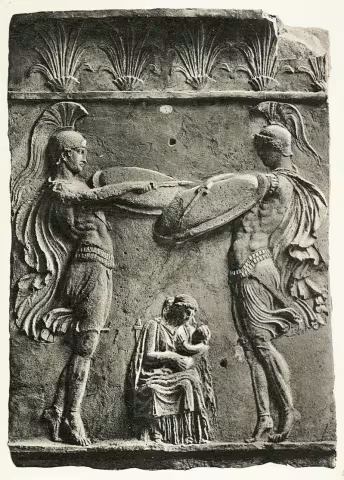
Amalthea's extant iconography in ancient Greek and Roman art is limited. She is represented either as a nymph or a goat, the latter the more common form. On a Campana relief (a type of Roman terracotta relief) dating to the late 1st century BC or early 1st century AD, she is shown nursing Zeus (who sits in her lap) without the presence of a goat; two Kouretes carry swords and shields, one on each side of her. As a goat, Amalthea is often shown suckling Zeus, or with the child mounted upon her back. A 2nd-century AD marble relief depicts her as a goat giving the child her milk, behind two dancing Kouretes who clang their swords on their shields. Amalthea is also depicted on coins and medallions from the Roman Empire, including those from the reigns of Titus (79–81 AD) and Gallienus (253–268 AD). Coins from Crete and Anatolia (modern-day Turkey) portray her as a nymph holding Zeus, sometimes with a cornucopia present.
Modern
-
 Giulio Romano's The Nurture of Jupiter (created shortly after 1533)
 -
 Giorgio Vasari's The Infancy of Jupiter (1555–1556)
 -

-
 Jacob Jordaens's The Infant Jupiter Fed by the Goat Amalthea (c. 1630–1635)
 -
 Nicolas Poussin's The Nurture of Jupiter (c. 1639)
.jpg)
.jpg)
.jpg)
_by_Jakob_Jordaens.jpg)


Amalthea was represented as a goat by the Italian artist Giulio Romano, in a painting executed shortly after 1533 as part of a series of twelve works illustrating scenes from Jupiter's upbringing. She is shown with her rear end raised in the air by a nymph, below which the child drinks from her teats. A painting of Amalthea as a nymph, executed by the Italian artist Giorgio Vasari in 1555 or 1556, was afforded a central position in the Sala di Giove ('Room of Jupiter') of the Palazzo Vecchio, located in Florence. In his own writings, Vasari explains the work's meaning: the child Jupiter, who represents Cosimo I de' Medici (the Duke of Florence and the building's owner), receives foresight from the goat milk fed to him by Amalthea and wisdom from the honey provided by the nymph Melissa.
Amalthea was the subject of a sculpture attributed to the Baroque sculptor Gian Lorenzo Bernini, among his first works, produced before 1615 (in which year he turned 17). It depicts Amalthea as a goat, with the infant Jupiter drinking her milk, accompanied by a miniature satyr; it diverges from the ancient artistic tradition by having Jupiter feed himself. The realistic carving of the statue's surface is reminiscent of that of Hellenistic sculptures, and until recent times it was thought to have been produced in antiquity. It was under the ownership of the cardinal Scipione Borghese by 1615, and may have been seen as containing a political meaning: Amalthea, embodying abundance, may have symbolised the "Golden Age" ushered in under the papacy of Pope Paul V (who was also part of the Borghese family).
The myth of the goat Amalthea was a favourite subject of the Flemish painter Jacob Jordaens. Around 1630 to 1635, he created a painting in which Amalthea is being milked by Adrasteia beside a young, bawling Jupiter, bottle in hand. A print after this painting by the Frisian engraver Schelte a Bolswert is accompanied by a Latin inscription which presents a moral interpretation of the myth: it explains that Jupiter's adulterous proclivities are unsurprising given he was raised amongst satyrs, on the milk of a goat. Jordaens's other paintings of Amalthea include elements such as a satyr playing a flute or tambourine, and a nymph holding a milk pitcher while looking at the audience. Around 1636 to 1637, the French painter Nicolas Poussin created a painting of the myth of Amalthea inspired by an engraving (after Romano's painting) by the 16th-century Italian artist Giulio Bonasone. Poussin's second painting of the scene, dating to around 1639, portrays Amalthea as a woman holding a valuable receptacle containing goat's milk, from which the child drinks.
In 1787, the French sculptor Pierre Julien completed a white marble statue depicting Amalthea as a nymph, seated on a rock, with her hand grasping the lead of her goat. Julien's Amalthea is a young, nude woman endowed with full hips, her pose echoing the Venus de' Medici. The sculpture was the central element of the dairy at Rambouillet, which Louis XVI had commissioned for his wife Marie Antoinette. Installed in 1787, the statue was situated in a grotto within the building, a placement Meredith Martin sees as indicating that the dairy was an allusion to the cave from the myth of Jupiter's upbringing; this grotto included artificial rocks, flowing water, and a skylight. Along the walls of the room that contained the grotto were two friezes, one of which depicted Amalthea as a goat, nursing Jupiter.
See also
- Heiðrún, cosmic goat in Norse mythology
- Human–animal breastfeeding
Notes
- ^ Henig, pp. 582–583; Digital LIMC 45699 (Amaltheia 2).
- ^ Pearson, p. 60.
- ^ For lists of 19th-century proposals, see Gruppe, pp. 824–825 n. 9, and Roscher, p. 265. The two mentioned here are from Roscher; the second relies on the Iliad's use of amalḗ to describe lambs.
- ^ Pearson, p. 60. For these translations, see Montanari, s.vv. ἀμάλη, ἀμαλλα, ἀμαλός, p. 101.
- ^ Montanari, s.v. ἀμαλθεύω, p. 83.
- ^ Pearson, p. 60. He writes that Gruppe's theory was refuted by the discovery of amaltheúein, previously attested only in later sources, in a fragment from the writings of the 5th-century BC tragedian Sophocles; Amalthea only appears as Zeus's nurturer in sources which date to after this period. For this fragment, see Sophocles, fr. 95 TrGF (Radt, p. 148) [= Photius, Lexicon s.v. Ἀμαλθεύειν (Reitzenstein, p. 86)].
- ^ Mussies, "I. Name", para. 1.
- ^ Gantz, p. 28; West 1966, p. 300 on line 484.
- ^ Hutchinson, p. 201.
- ^ Hard 2004, p. 74; Hesiod, Theogony 484 (Most, pp. 40–41). The translation used here is that from Hard.
- ^ Willetts, p. 120; Astour, p. 314 n. 18; Hutchinson, pp. 201–202. On the meaning of aigós, see Montanari, s.v. αἴξ, p. 54.
- ^ West 1966, p. 300 on line 484; López-Riuz, p. 45.
- ^ Athanassakis, p. 47 on lines 459–501.
- ^ Metropolitan Museum of Art 30.115.21.
- ^ a b Hard 2004, p. 280.
- ^ Fontenrose, p. 350; Henig, p. 582.
- ^ On the stories as initially independent, see: Miller, p. 223; Fowler 2013, pp. 323–324; Bremmer, para. 1; West 1983, p. 131. On the uncertainty as to when they were merged, see § Merging of traditions.
- ^ Fowler 2013, p. 324; Gantz, p. 41; Anacreon, fr. 361 PMG (Page, p. 184); Phocylides, fr. 7 Gerber (pp. 396, 397). For Anacreon and Phocylides as dating to as early as the 6th century BC, see Robbins, "A. Life", para. 1, and Bowie, para. 1.
- ^ Bremmer, para. 1; Fowler 2013, p. 324; Aristophanes, fr. 707 PCG (Kassel & Austin 1984, p. 362); Cratinus, fr. 261 PCG (Kassel & Austin 1983, p. 255); Antiphanes, fr. 108 PCG (Kassel & Austin 1991, p. 368).
- ^ Hunter, pp. 27, 89–90.
- ^ Fowler 2013, p. 323; Stephens, p. 64 on lines 48–49; Pherecydes, fr. 42 Fowler (2000, p. 303) [= FGrHist 3 F42 = Apollodorus, 2.7.5 (Frazer 1921, pp. 256–257)].
- ^ Davies, pp. xii–xiii; Gantz, p. 28; Pindar, fr. 70b (249a) Maehler (p. 77) [= Scholia D on the Iliad, 21.194 (Dindorf, p. 218)].
- ^ Fowler 2013, p. 323; Apollodorus, 2.7.5 (Frazer 1921, pp. 256–257). A mythical figure named Haemon is the father of Thessalus, who was thought to be the eponym of the region of Thessaly (Binder, para. 1).
- ^ Gantz, p. 42 (Apollodorus); Henig, p. 582 (Philemon); Apollodorus, 2.7.5 (Frazer 1921, pp. 256–257); Philemon, fr. 68 PCG (Kassel & Austin 1989, p. 261). According to Gantz, Apollodorus's source for this may be Pherecydes, whom he cites immediately afterwards.
- ^ Wernicke, para. 4; Diodorus Siculus, 4.35.3–4 (Oldfather 1935, pp. 456–457); Strabo, 10.2.19 (Jones 1928, pp. 56–57). For other versions of this myth, including those in which Amalthea is not mentioned, see Achelous § Heracles and Deianeira.
- ^ Kerényi, p. 93.
- ^ Grimal, s.v. Amalthea, p. 35, describes it as "most usual form of the story".
- ^ West 1983, pp. 41–43, 132; Gantz, p. 41. West 1983, p. 5, suggests a date in the latter part of the 4th century BC, though Betegh, pp. 346–347, disagrees with West's assessment that the work was composed this late, and argues that content from the text was referenced by the 4th-century BC philosopher Eudemus of Rhodes.
- ^ Musaeus fr. 8 Diels (pp. 181–182) [= Eratosthenes, Catasterismi (Hard 2015, p. 44)]. On the Catasterismi and the summary by Pseudo-Eratosthenes, see Kanas, p. 109.
- ^ Gee, pp. 131–132; Gantz, p. 41; Frazer 1929a, p. 120.
- ^ Gee, p. 132; Gantz, p. 41.
- ^ a b Gantz, p. 41.
- ^ Frazer 1929b, p. 12; Musaeus, fr. 84 III Bernabé (2007, p. 43) [= Hyginus, De astronomia 2.13.6–7 (Hard 2015, pp. 44–45)].
- ^ The work was attributed in antiquity to the Roman author Gaius Julius Hyginus; for this dating and attribution, see Hard 2004, p. 13.
- ^ Gantz, p. 41. According to Gantz, this conclusion is "clearly intended" in Pseudo-Eratosthenes's account. On the aegis, see Parker, para. 1.
- ^ a b Bremmer, para. 1.
- ^ Fowler 2013, p. 324.
- ^ Hard 2004, pp. 75, 612. According to Gantz, p. 41, Callimachus "seems the first" to do so.
- ^ Boyd, p. 73; Callimachus, Hymn to Zeus 33–49 (Clayman, pp. 186–187).
- ^ Stephens, p. 64 on lines 48–49. Kirichenko, p. 192, writes that Callimachus's account of Zeus's raising in Crete is "characterized by a complete elimination of the supernatural element", of which the transformation of the nymph Amalthea into a goat is one part.
- ^ Campbell, p. 322; Miller, p. 223; Hansen, p. 325; Scholia on Callimachus's Hymn to Zeus, 49 (Miller, p. 223 n. 9).
- ^ Larson, p. 185; Diodorus Siculus, 5.70.2–3 (Oldfather 1939, pp. 284–287).
- ^ Farnell, p. 97; Diodorus Siculus, 5.70.6 (Oldfather 1939, pp. 286–289). For this translation, see Oldfather 1939, p. 289 n. 1.
- ^ Gantz, p. 41; Scholia D on the Iliad, 15.229 (Dindorf, p. 72). This version specifies that it is Themis who provides the oracle directing Zeus to use the goat's skin. Part of the scholium's account also seems to have been preserved in P. Oxy. 3003 col. ii.15–19 (Parsons, p. 17); see Parsons, p. 19.
- ^ Hard 2015, p. 46.
- ^ Kidd, p. 239; Aratus, Phaenomena 155–161 (Mair & Mair, pp. 218–219). For the modern names of the constellation and star, see Mair & Mair's note g and note h.
- ^ Chrysanthou, p. 166.
- ^ Hard 2015, pp. 46–47; Aratus, Phaenomena 163 (Mair & Mair, pp. 218–219).
- ^ McLennan, p. 81.
- ^ Kidd, p. 242 on line 163.
- ^ Hard 2015, p. 47 (calls her Olenian, interpretations); Mair & Mair, p. 221 n. a (interpretations); Aratus, Phaenomena 164 (Mair & Mair, pp. 218–221). For the first interpretation, see Strabo, 8.7.5 (Jones 1927, pp. 222–223).
- ^ Fowler 2013, p. 323 n. 212; Boyd, p. 73 n. 28.
- ^ Henig, p. 582; Scholia on Aratus, 164 (Kidd, p. 243 on line 164). Fowler 2013, p. 323 n. 212, compares this with Hyginus, De astronomia 2.13.5 (Hard 2015, p. 44), in which Aix and Helice, nurses of Zeus, are daughters of Olenus. For a more detailed discussions of possible explanations for this word, see Bömer, pp. 298–299 on line 113, Frazer 1929b, pp. 11–12, and Boyd, p. 73 with n. 28.
- ^ Olivieri, p. 17 with n. 22–23; Hard 2015, p. 42; Santoni, p. 190 n. 118 to p. 91.
- ^ Gee, p. 132 with n. 20.
- ^ Fowler 2013, pp. 323–324.
- ^ Ovid, Fasti 5.111–128 (Boyle & Woodard, pp. 116–117).
- ^ Gantz, p. 41; Campbell, p. 322.
- ^ Gee, p. 131; Hard 2015, p. 47.
- ^ Boyle & Woodard, p. 258 on lines 5.111–114.
- ^ Gantz, p. 41; Hard 2004, p. 280.
- ^ Gee, p. 131 with n. 17 (placed in heavens); Boyle & Woodard, pp. 258 on lines 1.111–114, 259 on lines 5.127–128 (as Capella). According to Boyle & Woodard, Ovid may have considered Capricornus ('Goat's Horn') to be the constellation into which the horn is transformed.
- ^ Miller, pp. 218, 225.
- ^ Miller, pp. 219–220, 222; Frazer 1929b, p. 12.
- ^ Gee, p. 132.
- ^ Miller, p. 220.
- ^ The initial phrase of Ovid's narrative (line 5.111) is ab Iove surgat opus, translated as "let the work rise from Jove" by Boyle & Woodard, p. 116; Aratus begins with ἐκ Διὸς ἀρχώμεσθα, translated as "let us begin from Zeus" by Miller (Miller, p. 221).
- ^ Miller, pp. 221–222. Miller also points to Ovid's choice to describe the goat as having two kids, which hints at the constellation of the Kids, mentioned by Aratus as sitting beside that of the goat (and as her offspring).
- ^ Boyd, p. 72. According to Boyd, Ovid "makes Callimachus both the primary model and the focus of his narrative". Miller, p. 218, argues that Boyd "downplays the extent of Ovid's engagement with Aratus here, and correspondingly somewhat overemphasizes the admittedly important Callimachean background".
- ^ Miller, p. 223; Scholia on Aratus, 156 (Jean Martin, pp. 158–159).
- ^ Gee, p. 134 with n. 27. According to Gee, "we can surmise this from our knowledge of the tradition recorded by Pherecydes".
- ^ Miller, p. 223.
- ^ a b Henig, p. 583; Digital LIMC 1942 (Amaltheia 6). For the figures in this relief as Kouretes, see Buddensieg, p. 129.
- ^ Hyginus, Fabulae 139 (Smith & Trzaskoma, p. 146; Marshall, pp. 122–123). Most scholars now consider this attribution spurious; on the work's date and attribution, see Hard 2004, p. 13.
- ^ In the Theogony, Cronus, one of the Titans, swallows the first five of his children – Hestia, Demeter, Hera, Hades, and Poseidon – upon the birth of each. Because of this, their mother Rhea gives Cronus a stone to swallow in place of their sixth child, Zeus (Hard 2004, pp. 67–68).
- ^ Gantz, p. 42. In the Fabulae, instead of being swallowed, Poseidon is thrown by Cronus into the ocean, and Hades is cast by him into the underworld. Hera is not swallowed either, as she transports the newborn Zeus.
- ^ Kerényi, pp. 93–94.
- ^ This is the interpretation of Henig, p. 582.
- ^ Hard 2004, p. 75; Kerényi, pp. 93–94; Henig, p. 582. The quoted translation is that given by Smith & Trzaskoma, p. 146.
- ^ Kerényi, p. 94. The Kouretes (also referred to as the Corybantes) are included in accounts of Zeus's infancy from as early as Callimachus, and are commonly described as performing their clangorous dance around the entrance to the cave in which the infant is nursed (Hard 2004, p. 75).
- ^ Nilsson, p. 480 n. 6.
- ^ Hyginus, Fabulae 182 (Smith & Trzaskoma, p. 158; Marshall, p. 152). Marshall gives the names of the three daughters as Idyia, Althaea, and Adrasta.
- ^ See, for example, West 1983, p. 133 n. 40, and Smith & Trzaskoma, p. 191 on line 182.
- ^ This is the interpretation of Fowler 2013, p. 323.
- ^ Smith & Trzaskoma, pp. 158, 191 to line 182.
- ^ Fowler 2013, p. 323 n. 212; Frey, para. 1. Hyginus also states that these three are "the ones that are called Dodonian Nymphs (others call them the Naiads)" (Smith & Trzaskoma, p. 158).
- ^ On this figure, see Frey, para. 1.
- ^ Frey, para. 1; Braswell, p. 158; Didymus on Pindar, fr. 14b Braswell (pp. 155–157)] [= Lactantius, Divine Institutes (Bowen & Garnsey, p. 114)].
- ^ West 1983, pp. 122–123; Apollodorus, 1.1.6–7 (Frazer 1921, pp. 6–7).
- ^ On the Orphic Rhapsodies, see Graf, para. 2. For this dating, see Meisner, p. 1.
- ^ On Hermias's mention of this detail, see: West 1983, p. 133 n. 37; Orphic frr. 209 I Bernabé (2004, pp. 181–182), 209 II Bernabé (2004, pp. 182–183).
- ^ Brisson, V p. 61; West 1983, pp. 72, 122–123.
- ^ Bernabé 2008, p. 315. Compare with Meisner, p. 219, who states that in the Rhapsodies Zeus is "nursed by a triad of nymphs: Ida, Adrasteia, and Amaltheia".
- ^ Gantz, p. 42.
- ^ Bernabé 2004, p. 182.
- ^ Smith, s.v. Amalthea; Diodorus Siculus, 3.68.1 (Oldfather 1935, pp. 308–309).
- ^ Sauron 2007, p. 42. An example of a location referred to as "Amalthea's horn" was a spot in a well-watered grove belonging to the Sicilian tyrant Gelon, who lived around the early 5th century BC. This location is mentioned by Athenaeus, Deipnosophistae 12.542a (Olson, pp. 152–153).
- ^ Winiarczyk, p. 127; Diodorus Siculus, 3.74.1 (Oldfather 1935, pp. 328–329).
- ^ Sinn, p. 207; Sauron 1991, p. 9; Sauron 2007, p. 42.
- ^ Sauron 1991, pp. 5–6. On the various proposals made up to 1906 regarding the Amaltheum's form, see Moore, pp. 122–123.
- ^ Bremmer, para. 1; Mussies, "II. Identity", para. 2; Zenobius, 2.48 (Schneidewin, pp. 44–45).
- ^ Hyginus, De astronomia 2.13.5 (Hard 2015, p. 44). On Jupiter as the equivalent of Zeus in Latin literature, see Hard 2004, p. xvi.
- ^ Vian, p. 309; Hyginus, De astronomia 2.28.1 (Hard 2015, p. 79). On Aegipan, see Tripp, s.v. Aegipan, p. 20.
- ^ Vian, p. 309; Nonnus, Dionysiaca 27.298 (Rouse, pp. 340–341).
- ^ Reeder, p. 38; Preimesberger, p. 60.
- ^ Henig, pp. 582–583; Preimesberger, p. 60. According to Henig, some works identified as depictions of the goat Amalthea may instead represent the goat she owns.
- ^ Henig, pp. 582–583 (type and date of relief, nursing, Kouretes); Buddensieg, pp. 128–129 with n. 19 (in lap, without a goat); Digital LIMC 45699 (Amaltheia 2). On Campana reliefs, see Stone, p. 148.
- ^ Henig, p. 583.
- ^ Woods, pp. 189–190; Preimesberger, pp. 63–64.
- ^ Wernicke, para. 9.
- ^ Meredith Martin, p. 57; Royal Collection 402781. The date used here is that from Martin.
- ^ Van Veen, p. 23.
- ^ Preimesberger, p. 53; Galleria Borghese CXVIII.
- ^ d'Hulst, p. 148; Louvre 1405. The date given here is the one from d'Hulst.
- ^ Verdi, p. 208; Staatliche Museen zu Berlin DPG234. The date given here is that from Verdi.
- ^ Draper & Scherf, pp. 185–186; Louvre CC 230. The date given here is the one from Draper & Scherf.
- ^ Meredith Martin, p. 57. On Amalthea as a goat in this painting, see Hartt, p. 212.
- ^ Bull, p. 143. For a nymph as the one who raises her legs, see Hartt, p. 212.
- ^ Preimesberger, pp. 62–63. For this date, see Van Veen, p. 23. This article follows Preimesberger in identifying Amalthea as one of the nymphs; Van Veen, p. 22 describes her as a "goat/nymph" in the painting.
- ^ Preimesberger, p. 63.
- ^ Zirpolo, p. 90; Preimesberger, pp. 53, 59. For Bernini's birth year as 1598, see Hibbard, p. 23.
- ^ Preimesberger, pp. 60–61.
- ^ Hibbard, p. 26.
- ^ Zirpolo, p. 90; Hibbard, p. 25. Wittkower, p. 110, writing in 1975, said that this belief was held "until a generation ago".
- ^ Preimesberger, pp. 53, 62.
- ^ Sutton, p. 147; d'Hulst, De Poorter & Vandenven, p. 24.
- ^ d'Hulst, De Poorter & Vandenven, p. 154.
- ^ Preimesberger, pp. 64–65. For an image of the engraving, see File:Jupiter als kind gevoed met melk van de geit Amalthea, RP-P-BI-2610.jpg.
- ^ Auwera & Schaudies, p. 116 (satyr playing flute, nymph with pitcher); Sutton, p. 147 (satyr with tambourine).
- ^ Verdi, p. 207.
- ^ Verdi, pp. 207–208.
- ^ Draper & Scherf, p. 186. For the statue's subject as nude, see Meredith Martin, p. 227.
- ^ Levey, p. 248.
- ^ Scherf, p. 126.
- ^ Meredith Martin, pp. 227, 236. For the date of the statue's installation, see Scherf, p. 126.
- ^ Lavagne, p. 265. For images of the sculpture while placed in the grotto, see Heitzmann, p. 51 fig. 11–12.
- ^ Heitzmann, p. 53.
References
- Astour, Michael C., "Aegean Place-Names in an Egyptian Inscription", in American Journal of Archaeology, Vol. 70, No. 4, pp. 313–317, 1966. JSTOR 502320.
- Athanassakis, Apostolos N., Hesiod: Theogony, Works and Days, Shield, Baltimore, Johns Hopkins University Press, 2022. ISBN 9781421443959.
- Auwera, Joost Vander, and Irene Schaudies, Jordaens and the Antique, Brussels, Mercatorfonds, 2012. ISBN 9789061536758.
- Bernabé, Alberto (2004), Poetae epici Graeci: Testimonia et fragmenta, Pars II: Orphicorum et Orphicis similium testimonia et fragmenta, Fasc 1, Bibliotheca Teubneriana, Munich and Leipzig, K. G. Saur Verlag, 2004. ISBN 3598717075. doi:10.1515/9783110943702.
- Bernabé, Alberto (2007), Poetae epici Graeci: Testimonia et fragmenta, Pars II: Musaeus. Linus. Epimenides. Papyrus Derveni. Indices, Fasc 3, Bibliotheca Teubneriana, Berlin, De Gruyter, 2007. ISBN 9783110194876. doi:10.1515/9783110926392.
- Bernabé, Alberto (2008), "Teogonías Órficas", in Orfeo y la tradición órfica, pp. 291–324, edited by Alberto Bernabé and Fransec Casadesús, Madrid, Akal, 2008. ISBN 9788446018964.
- Betegh, Gábor, "On Eudemus Fr. 150 (Wehrli)", in Eudemus of Rhodes, pp. 337–357, edited by István Bodnár and William W. Fortenbaugh, Abingdon and New York, Routledge, 2002. ISBN 9780765801340. doi:10.4324/9781351324489.
- Binder, Carsten, "Thessalus (1)", in Brill's New Pauly: Encyclopaedia of the Ancient World. Antiquity, Volume 14, Sym – Tub, edited by Hubert Cancik and Helmuth Schneider, Leiden, Brill, 2009. ISBN 9789004142190. Internet Archive.
- Bömer, Franz, P. Ovidius Naso: Die Fasten. Band II: Kommentar, Heidelberg, Universitätsverlag Winter, 1958. OCLC 6985387. Internet Archive.
- Bowen, Anthony, and Peter Garnsey, Lactantius: Divine Institutes, Liverpool, Liverpool University Press, 2003. ISBN 0853239886. Internet Archive.
- Bowie, Ewen, "Phocylides (1)", in Brill's New Pauly: Encyclopaedia of the Ancient World. Antiquity, Volume 11, Phi – Prok, edited by Hubert Cancik and Helmuth Schneider, Leiden, Brill, 2007. ISBN 9789004142169. Internet Archive.
- Boyd, Barbara Weiden, "Celabitur Auctor: The Crisis of Authority and Narrative Patterning in Ovid Fasti 5", in Phoenix, Vol. 54, No. 1/2, pp. 64–98, 2000. JSTOR 1089091.
- Boyle, A. J., and R. D. Woodard, Ovid: Fasti, London and New York, Penguin Books, 2000. ISBN 0140446907. Internet Archive.
- Braswell, Bruce Karl, Didymos of Alexandria: Commentary on Pindar, Basel, Schwabe, 2017. ISBN 9783796534935.
- Bremmer, Jan N., "Amalthea", in Brill's New Pauly: Encyclopaedia of the Ancient World. Antiquity, Volume 1: A – Ari, edited by Hubert Cancik and Helmuth Schneider, Leiden and Boston, Brill, 2002. ISBN 9004122583.
- Brisson, Luc, Orphée et l'Orphisme dans l'Antiquité gréco-romaine, Aldershot, Variorum, 1995. ISBN 0860784533.
- Buddensieg, Tilmann, "Die Ziege Amalthea von Riccio und Falconetto", in Jahrbuch der Berliner Museen, Vol. 5, pp. 121–150, 1963. JSTOR 4125642.
- Bull, Malcolm, The Mirror of the Gods: Classical Mythology in Renaissance Art, London, Penguin, 2005. ISBN 9780140266085.
- Campbell, David A., Greek Lyric Poetry: A Selection of Early Greek Lyric, Elegiac and Iambic Poetry, London and New York, Bloomsbury, 1982. ISBN 9780862920081. Internet Archive.
- Chrysanthou, Anthi, Defining Orphism: The Beliefs, the Teletae and the Writings, Berlin and Boston, De Gruyter, 2020. ISBN 9783110678390. doi:10.1515/9783110678451.
- Clayman, Dee L., Callimachus. Hecale. Hymns. Epigrams, Loeb Classical Library No. 129, Cambridge, Massachusetts, Harvard University Press, 2022. ISBN 9780674997332. Loeb Classical Library.
- Davies, Gilbert Austin, The Trachiniae of Sophocles, London, Cambridge University Press, 1908. OCLC 1085959377. Internet Archive.
- Diels, Hermann A., Die Fragmente der Vorsokratiker, Volume II, Berlin, Weidmann, 1912. OCLC 551220179. Internet Archive.
- Dindorf, Karl Wilhelm, Scholia Graeca in Homeri Iliadem, Volume II, Oxford, Clarendon Press, 1875. OCLC 5197326. Internet Archive. Perseus Digital Library.
- Draper, James David, and Guilhem Scherf, Playing with Fire: European Terracotta Models, 1740–1840, New York, Metropolitan Museum of Art, 2003. ISBN 1588390993.
- Farnell, Lewis Richard, The Cults of the Greek States, Volume I, Oxford, Clarendon Press, 1896. OCLC 1042985779. Internet Archive.
- Fontenrose, Joseph Eddy, Python: A Study of Delphic Myth and Its Origins, Berkeley, Los Angeles, and London, University of California Press, 1959. ISBN 0520040910.
- Fowler, Robert L. (2000), Early Greek Mythography: Volume 1: Text and Introduction, Oxford, Oxford University Press, 2000. ISBN 9780198147404. doi:10.1093/actrade/9780198147404.book.1.
- Fowler, Robert L. (2013), Early Greek Mythography: Volume 2: Commentary, Oxford, Oxford University Press, 2013. ISBN 9780198147411. doi:10.1093/actrade/9780198147411.book.1.
- Frazer, James George (1921), Apollodorus. The Library, Volume I: Books 1–3.9, Loeb Classical Library No. 121, Cambridge, Massachusetts, Harvard University Press, 1921. ISBN 9780674991354. Loeb Classical Library. Perseus Digital Library.
- Frazer, James George (1929a), Fastorum Libri Sex: The Fasti of Ovid. Vol. III: Commentary on Books III and IV, London, Macmillan, 1929. OCLC 855468629. Internet Archive.
- Frazer, James George (1929b), Fastorum Libri Sex: The Fasti of Ovid. Vol. IV: Commentary on Books V and VI, London, Macmillan, 1929. OCLC 855468629. Internet Archive.
- Frey, Alexandra, "Melisseus", in Brill's New Pauly: Encyclopaedia of the Ancient World. Antiquity, Volume 8: Lyd – Mine, edited by Hubert Cancik and Helmuth Schneider, Leiden and Boston, Brill, 2006. ISBN 9004122710. Internet Archive.
- Gantz, Timothy, Early Greek Myth: A Guide to Literary and Artistic Sources, Baltimore, Johns Hopkins University Press, 1993. ISBN 080184410X. Internet Archive: Volume 1.
- Gee, Emma, Ovid, Aratus and Augustus: Astronomy in Ovid's Fasti, Cambridge, Cambridge University Press, 2000. ISBN 0521651875. Internet Archive.
- Gerber, Douglas E., Greek Elegiac Poetry: From the Seventh to the Fifth Centuries BC, Loeb Classical Library No. 258, Cambridge, Massachusetts, Harvard University Press, 1999. ISBN 9780674995826. Loeb Classical Library.
- Graf, Fritz, "Orphic literature", in Oxford Classical Dictionary, edited by Tim Whitmarsh, New York, Oxford University Press, 2016. ISBN 9780199381135.
- Grimal, Pierre, The Dictionary of Classical Mythology, Malden, Oxford, and Carlton, Blackwell Publishing, 1986. ISBN 0631201025. Internet Archive.
- Gruppe, Otto, Griechische Mythologie und Religionsgeschichte, Volume II, Munich, C. H. Beck, 1906. OCLC 3937254. Internet Archive.
- Hansen, William, Handbook of Classical Mythology, Santa Barbara, ABC-Clio, 2004. ISBN 1576072266. Internet Archive.
- Hard, Robin (2004), The Routledge Handbook of Greek Mythology: Based on H.J. Rose's "Handbook of Greek Mythology", London and New York, Routledge, 2004. ISBN 020344633X. doi:10.4324/9780203446331. Internet Archive.
- Hard, Robin (2015), Eratosthenes and Hyginus: Constellation Myths, With Aratus's Phaenomena, Oxford, Oxford University Press, 2015. ISBN 9780198716983.
- Hartt, Frederick, Giulio Romano. Volume I: Text, New Haven, Yale University Press, 1958. OCLC 962531465.
- Heitzmann, Annick, "La laiterie de Rambouillet", in Versalia. Revue de la Société des Amis de Versailles, Vol. 10, pp. 46–57, 2007. doi:10.3406/versa.2007.873.
- Henig, Martin, "Amaltheia", in Lexicon Iconographicum Mythologiae Classicae (LIMC). I.1: Aara – Aphlad, pp. 582–584, Zurich and Munich, Artemis Verlag, 1981. ISBN 3760887511. Internet Archive.
- Hibbard, Howard, Bernini, Harmondsworth, Penguin, 1965. OCLC 1940706. Internet Archive.
- d'Hulst, Roger Adolf, Jacob Jordaens (1593–1678). Volume II: Drawings and Prints, Brussels, Gemeentekrediet, 1993. ISBN 9050661181. Internet Archive.
- d'Hulst, Roger Adolf, Nora de Poorter, and Marc Vandenven, Jacob Jordaens (1593–1678). Volume I: Paintings and Tapestries, Brussels, Gemeentekrediet, 1993. ISBN 9050661173. Internet Archive.
- Hunter, Richard L., Eubulus: The Fragments, Cambridge, New York, and Melbourne, Cambridge University Press, 1983. ISBN 0521244366. Internet Archive.
- Hutchinson, Richard Wyatt, Prehistoric Crete, Baltimore, Penguin Books, 1962. OCLC 1683258. Internet Archive.
- Jones, Horace Leonard (1927), Strabo. Geography, Volume IV: Books 8–9, Loeb Classical Library No. 196, Cambridge, Massachusetts, Harvard University Press, 1927. ISBN 9780674992160. Loeb Classical Library. LacusCurtius.
- Jones, Horace Leonard (1928), Strabo. Geography, Volume V: Books 10–12, Loeb Classical Library No. 211, Cambridge, Massachusetts, Harvard University Press, 1928. ISBN 9780674992337. Loeb Classical Library. LacusCurtius.
- Kanas, Nick, Star Maps: History, Artistry, and Cartography, Chichester, Praxis, 2007. ISBN 9780387716688.
- Kassel, Rudolf, and Colin Austin (1983), Poetae Comici Graeci. Volumen IV: Aristophon – Crobylus, Berlin and New York, De Gruyter, 1983. ISBN 9783110024050. doi:10.1515/9783110826487.
- Kassel, Rudolf, and Colin Austin (1984), Poetae Comici Graeci. Volumen III,2: Aristophanes Testimonia et Fragmenta, Berlin and New York, De Gruyter, 1984. ISBN 9783110098938. doi:10.1515/9783110858556.
- Kassel, Rudolf, and Colin Austin (1989), Poetae Comici Graeci. Volumen VII: Menecrates – Xenophon, Berlin and New York, De Gruyter, 1989. ISBN 9783110120356. doi:10.1515/9783110886283.
- Kassel, Rudolf, and Colin Austin (1991), Poetae Comici Graeci. Volumen II: Agathenor – Aristonymus, Berlin and New York, De Gruyter, 1991. ISBN 9783110128406. doi:10.1515/9783110888058.
- Kerényi, Karl, The Gods of the Greeks, Thames and Hudson, London, 1951. OCLC 1385393775. Internet Archive.
- Kidd, Douglas, Aratus: Phaenomena, Cambridge, Cambridge University Press, 1997. ISBN 052158230X. Internet Archive.
- Kirichenko, Alexander, "Nothing to Do with Zeus? The Old and the New in Callimachus' First Hymn", in Gods and Religion in Hellenistic Poetry, pp. 181–201, edited by M. A. Harder, R. F. Regtuit, and G. C. Wakker, Leuven, Paris, Walpole, Peeters, 2012. ISBN 9789042924840. Academia.
- Larson, Jennifer, Greek Nymphs: Myth, Cult, Lore, New York, Oxford University Press, 2001. ISBN 0195122941.
- Lavagne, Henri, Operosa Antra. Recherches sur la grotte à Rome de Sylla à Hadrien, Rome, École française de Rome, 1988. ISBN 2728301530. doi:10.3406/befar.1988.1259.
- Levey, Michael, Painting and Sculpture in France: 1700–1789, New Haven and London, Yale University Press, 1972. ISBN 0300064942. Internet Archive.
- López-Riuz, Carolina, "Siting the Gods: Narrative, Cult, and Hybrid Communities in the Iron Age Mediterranean", in Gods and Mortals in Early Greek and Near Eastern Mythology, edited by Adrian Kelly and Christopher Metcalf, Cambridge, Cambridge University Press, 2021. ISBN 9781108570244.
- Maehler, Herwig, Pindarus Carmina cum fragmentis. Pars II: Fragmenta. Indices, Bibliotheca Teubneriana, Munich and Leipzig, K. G. Saur Verlag, 1989. ISBN 3598715862.
- Mair, A. W., and G. R. Mair, Callimachus, Lycophron, Aratus, Hymns and Epigrams. Lycophron: Alexandra. Aratus: Phaenomena, Loeb Classical Library No. 129, Cambridge, Massachusetts, Harvard University Press, 1921. ISBN 9780674991439. Loeb Classical Library.
- Marshall, Peter K., Hyginus: Fabulae, Bibliotheca Teubneriana, Munich and Leipzig, K. G. Saur Verlag, 2002 (2nd edition). ISBN 3598712375. doi:10.1515/9783110975512.
- Martin, Jean, Scholia in Aratum vetera, Bibliotheca Teubneriana, Leipzig, Teubner, 1974. ISBN 351901047X. Internet Archive.
- Martin, Meredith, Dairy Queens: The Politics of Pastoral Architecture from Catherini de' Medici to Marie-Antoinette, Cambridge, Massachusetts, and London, Harvard University Press, 2011. ISBN 9780674048997.
- McLennan, George Robert, Callimachus, Hymn to Zeus: Introduction and Commentary, Rome, Edizioni dell'Ateneo, 1977. OCLC 5075443.
- Meisner, Dwayne A., Orphic Tradition and the Birth of the Gods, Oxford, Oxford University Press, 2018. ISBN 9780190663520. doi:10.1093/oso/9780190663520.001.0001.
- Miller, John F., "Ovid and the Legend of Capella (Fasti 5.111–128)", in At the Crossroads of Greco-Roman History, Culture, and Religion: Papers in Memory of Carin M. C. Green, pp. 217–228, edited by Sinclair W. Bell and Lora L. Holland, Oxford, Archaeopress, 2018. ISBN 9781789690149. doi:10.2307/j.ctv1228gbp.
- Montanari, Franco, The Brill Dictionary of Ancient Greek, edited by Madeleine Goh and Chad Schroeder, Leiden, Brill, 2015. ISBN 9789004193185.
- Moore, Frank Gardner, "Cicero's Amaltheum", in Classical Philology, Vol. 1, No. 2, pp. 121–126, 1906. JSTOR 262255.
- Most, Glenn W., Hesiod, Theogony, Works and Days, Testimonia, Loeb Classical Library No. 57, Cambridge, Massachusetts, Harvard University Press, 2018. ISBN 9780674997202. Loeb Classical Library.
- Mussies, Gerard, "Amaltheia Ἀμάλθεια", in Dictionary of Deities and Demons in the Bible, edited by Karel van der Toorn, Bob Becking, and Pieter W. van der Horst, Leiden, Boston, and Cologne, Brill, 1999. ISBN 9004111190. Internet Archive.
- Nilsson, Martin P., The Minoan-Mycenaean Religion and Its Survival in Greek Religion, Lund, Gleerup, 1927. OCLC 4248815. Internet Archive.
- Oldfather, C. H. (1935), Diodorus Siculus. Library of History, Volume II: Books 2.35–4.58, Loeb Classical Library No. 303, Cambridge, Massachusetts, Harvard University Press, 1935. ISBN 9780674993341. Loeb Classical Library. LacusCurtius.
- Oldfather, C. H. (1939), Diodorus Siculus. Library of History, Volume III: Books 4.59–8, Loeb Classical Library No. 340, Cambridge, Massachusetts, Harvard University Press, 1939. ISBN 9780674993754. Loeb Classical Library. LacusCurtius.
- Olivieri, Alexander, Pseudo-Eratosthenis: Catasterismi, Bibliotheca Teubneriana, Leipzig, Teubner, 1897. OCLC 61949084. Internet Archive.
- Olson, S. Douglas, Athenaeus. The Learned Banqueters, Volume VI: Books 12–13.594b, Loeb Classical Library No. 327, Cambridge, Massachusetts, Harvard University Press, 2010. ISBN 9780674996397. Loeb Classical Library.
- Page, Denys Lionel, Poetae Melici Graeci, Oxford, Clarendon Press, 1962. ISBN 0198143338. Internet Archive.
- Parker, Robert, "Aegis", in Brill's New Pauly: Encyclopaedia of the Ancient World. Antiquity, Volume 1, A – Ari, edited by Hubert Cancik and Helmuth Schneider, Leiden, Brill, 2002. ISBN 9004122583.
- Parsons, Peter J., The Oxyrhynchus Papyri, Volume XLII, London, Egypt Exploration Society, 1974. OCLC 1123837201.
- Pearson, Alfred Chilton, The Fragments of Sophocles, Volume I, London and Edinburgh, Cambridge University Press, 1917. OCLC 947975027. Internet Archive.
- Preimesberger, Rudolf, Paragons and Paragone: Van Eyck, Raphael, Michelangelo, Caravaggio, and Bernini, Los Angeles, Getty Publications, 2011. ISBN 9780892369645.
- Radt, Stefan, Tragicorum Graecorum Fragmenta. Vol. 3: Aeschylus, Göttingen, Vandenhoeck & Ruprecht, 1985. ISBN 9783525257456.
- Reeder, Jane Clark, The Villa of Livia ad Gallinas Albas: A Study in the Augustan Villa and Garden, Providence, Center for Old World Archaeology and Art, 2001. ISBN 0974860980.
- Reitzenstein, Richard August, Der Anfang des Lexikons des Photios, Leipzig, Teubner, 1907. OCLC 10236429. Internet Archive.
- Robbins, Emmet, "Anacreon (1)", in Brill's New Pauly: Encyclopaedia of the Ancient World. Antiquity, Volume 1, A – Ari, edited by Hubert Cancik and Helmuth Schneider, Leiden, Brill, 2002. ISBN 9004122583.
- Roscher, Wilhelm Heinrich, Ausführliches Lexikon der griechischen und römischen Mythologie, Leipzig, Teubner, 1884. OCLC 902817350. Internet Archive.
- Rouse, W. H. D., Nonnos. Dionysiaca, Volume II: Books 16–35, Loeb Classical Library No. 345, Cambridge, Massachusetts, Harvard University Press, 1940. ISBN 9780674993914. Loeb Classical Library. Internet Archive.
- Santoni, Anna, Eratostene: Epitome dei Catasterismi, Pisa, Edizioni ETS, 2009. ISBN 9788846726452.
- Sauron, Gilles (1991), "De Buthrote à Sperlonga: À propos d'une étude récente sur le thème de la grotte dans les décors romains", in Revue Archéologique, Vol. 1, pp. 3–42, 1991. JSTOR 41745095.
- Sauron, Gilles (2007), "? Un 'Amaltheum' dans la villa d'Oplontis/Torre Annunziata", in Rivista di Studi Pompeiani, Vol. 18, pp. 41–46, 2007. JSTOR 44291142.
- Scherf, Guilhem, "Pierre Julien: Junges Mädchen mit Ziege (Jeune fille à la chèvre)", in Skulptur aus dem Louvre: 89 Werke des französischen Klassizismus, 1770–1830, pp. 126–127, edited by Christoph Brockhaus, Paris, Association Française d'Action Artistique, 1989. ISBN 3923576544.
- Schneidewin, Friedrich Wilhelm, Corpus Paroemiographorum Graecorum: Tomus I, Göttingen, Vandenhoeck & Ruprecht, 1839. OCLC 910311709. Internet Archive.
- Sinn, Friederike, Vatikanische Museen. Museo Gregoriano Profano ex Lateranense. Katalog der Skulpturen. Band III: Reliefgeschmückte Gattungen römischer Lebenskultur. Griechische Originalskulptur. Monumente orientalischer Kulte, Wiesbaden, Reichert, 2006. ISBN 9783895003936.
- Smith, Scott R., and Stephen M. Trzaskoma, Apollodorus' Library and Hyginus' Fabulae: Two Handbooks of Greek Mythology, Indianapolis and Cambridge, Hackett Publishing, 2007. ISBN 9780872208216. Internet Archive.
- Smith, William, Dictionary of Greek and Roman Biography and Mythology, London, John Murray, 1873. OCLC 681106410. Perseus Digital Library.
- Stephens, Susan A., Callimachus: The Hymns, Oxford and New York, Oxford University Press, 2015. ISBN 9780190266783.
- Stone, Shelley, "5.2. Campana Reliefs", in The Collection of Antiquities of the American Academy in Rome, pp. 148–153, edited by Larissa Bonfante and Helen Nagy, USA, University of Michigan, 2015. ISBN 9780472119899.
- Sutton, Peter C., Northern European Paintings in the Philadelphia Museum of Art: From the Sixteenth Through the Nineteenth Century, Philadelphia, Philadelphia Museum of Art, 1990. ISBN 0876330820. Internet Archive.
- Tripp, Edward, Crowell's Handbook of Classical Mythology, New York, Thomas Y. Crowell, 1970. ISBN 069022608X. Internet Archive.
- van Veen, Henk, Cosimo I de' Medici and His Self-Presentation in Florentine Art and Culture, Cambridge, Cambridge University Press, 2006. ISBN 0521837227.
- Verdi, Richard, Nicolas Poussin: 1594–1665, London, Zwemmer, 1995. ISBN 0302006478. Internet Archive.
- Vian, Francis, Nonnos de Panopolis, Les Dionysiaques. Tome V: Chants XI–XIII, Collection Budé, Paris, Les Belles Lettres, 1990. ISBN 225100419X.
- Wernicke, Konrad, "Amaltheia (1)", in Realencyclopädie der classischen Altertumswissenschaft, Band I, Halbband 2, edited by Georg Wissowa, Stuttgart, J. B. Metzler, 1894. OCLC 1083364219. Wikisource.
- West, Martin Litchfield (1966), Hesiod: Theogony, Oxford, Clarendon Press, 1966. ISBN 0198141696. Internet Archiive.
- West, Martin Litchfield (1983), The Orphic Poems, Oxford, Clarendon Press, 1983. ISBN 0198148542.
- Willetts, R. F., Ancient Crete: A Social History: From Early Times until the Roman Occupation, Abingdon, Routledge, 1965. ISBN 9780415412711.
- Winiarczyk, Marek, The "Sacred History" of Euhemerus of Messene, Berlin and Boston, De Gruyter, 2013. ISBN 9783110278880. doi:10.1515/9783110294880.
- Wittkower, Rudolf, Bernini: The Sculptor of the Roman Baroque, London, Phaidon, 1997. ISBN 0714837156. Internet Archive.
- Woods, David, "Gallienus, Amalthea, and the Pietas Faleri", American Journal of Numismatics, Vol. 31, pp. 189–206, 2019. JSTOR 27095032.
- Zirpolo, Lilian H., Historical Dictionary of Baroque Art and Architecture, Lanham, Toronto, and Plymouth, Scarecrow Press, 2010. ISBN 9780810874947. Internet Archive.
External links
 Media related to Amalthea (mythology) at Wikimedia Commons

